

Graph Drawing and Network Visualization
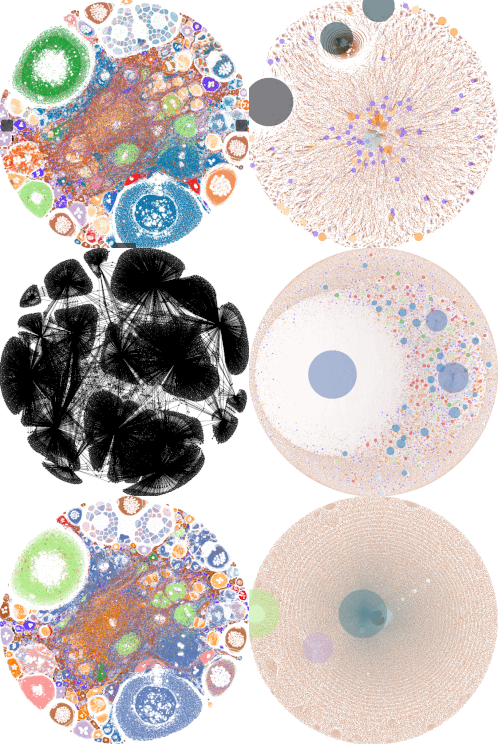 Graph drawing investigates how to construct geometric representations of graphs. Beyond its theoretical foundations, the field supports a wide range of practical applications, including VLSI circuit layout, social network analysis, software visualization, geometric routing, and bioinformatics. Our research investigates the fundamental limits of graph‑drawing aesthetics—such as minimizing crossings, bends, area, or edge complexity—and studies how these constraints influence the structure of feasible drawings. We also develop efficient algorithms that construct graph layouts tailored to the requirements of real‑world applications, ensuring that the resulting visualizations are both mathematically sound and practically useful.
Computational Geometry
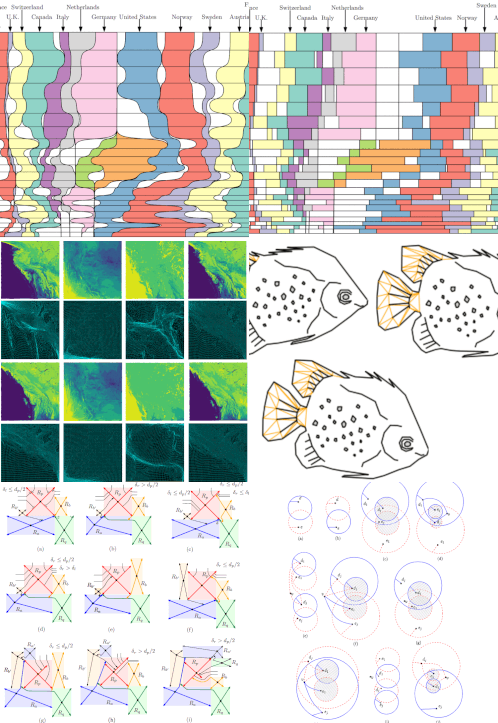 Computational geometry focuses on the design and analysis of algorithms for solving geometric problems, many of which arise naturally in both theoretical and applied settings. Such problems appear in diverse areas including robot motion planning, spatial data management, database search, computer graphics, geographic information systems, and numerous other domains where geometric structure plays a central role. Our research develops efficient algorithms to address these geometric challenges and analyzes their performance using tools from discrete mathematics, combinatorics, and algorithmic theory. By combining rigorous analysis with practical considerations, we aim to produce geometric algorithms that are efficient and well‑suited for real‑world applications.
Visual Analytics of Big Data
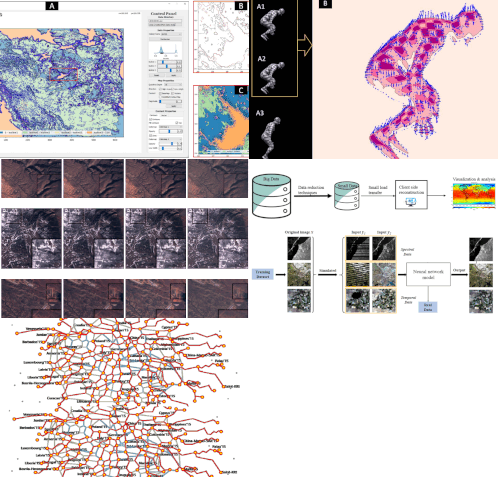 Our lives today are shaped by information technology, which continually exposes us to massive and rapidly growing volumes of data. Visualization has emerged as one of the most effective tools for making sense of such large and complex information. A well‑designed visualization can reveal essential patterns, highlight key properties of the data, and support users in making informed decisions. Our research investigates how to construct concise yet expressive visual summaries of large datasets. We aim to design visualization techniques that uncover meaningful structures, emphasize important features, and provide intuitive insights into the underlying information. By combining algorithmic methods with principles of visual perception, we develop approaches that help users interpret data more effectively and efficiently.
Graphs and Combinatorics
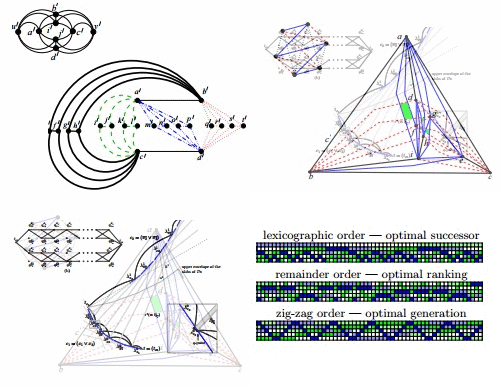 Graphs are fundamental structures used to represent a wide variety of relational data. Many computational problems (both theoretical and practical) are routinely modeled and solved using graph‑based formulations. Our research examines graph structures that satisfy specific combinatorial or geometric constraints, and investigates algorithmic questions that arise from these settings. In particular, we study problems such as graph enumeration, coloring, and structural characterization, with the goal of understanding how these constraints influence the complexity and behavior of graph algorithms. Through this work, we aim to develop deeper insights into graph properties and design efficient methods for solving graph‑theoretic problems that appear across diverse application domains.
Interdisciplinary research
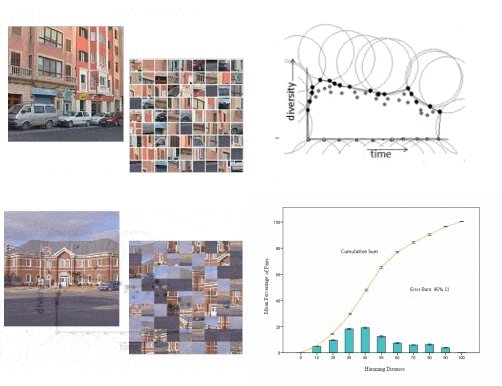 The tools and techniques developed for solving geometric and graph‑theoretical problems have broad applicability across many areas of computer science. These methods provide powerful ways to model structure, reason about complexity, and design efficient algorithms. We are particularly interested in extending these concepts through machine learning and artificial intelligence, especially in interdisciplinary domains where geometric and combinatorial insights can enhance analysis, improve automation, and deepen our understanding of underlying data and system behavior.