

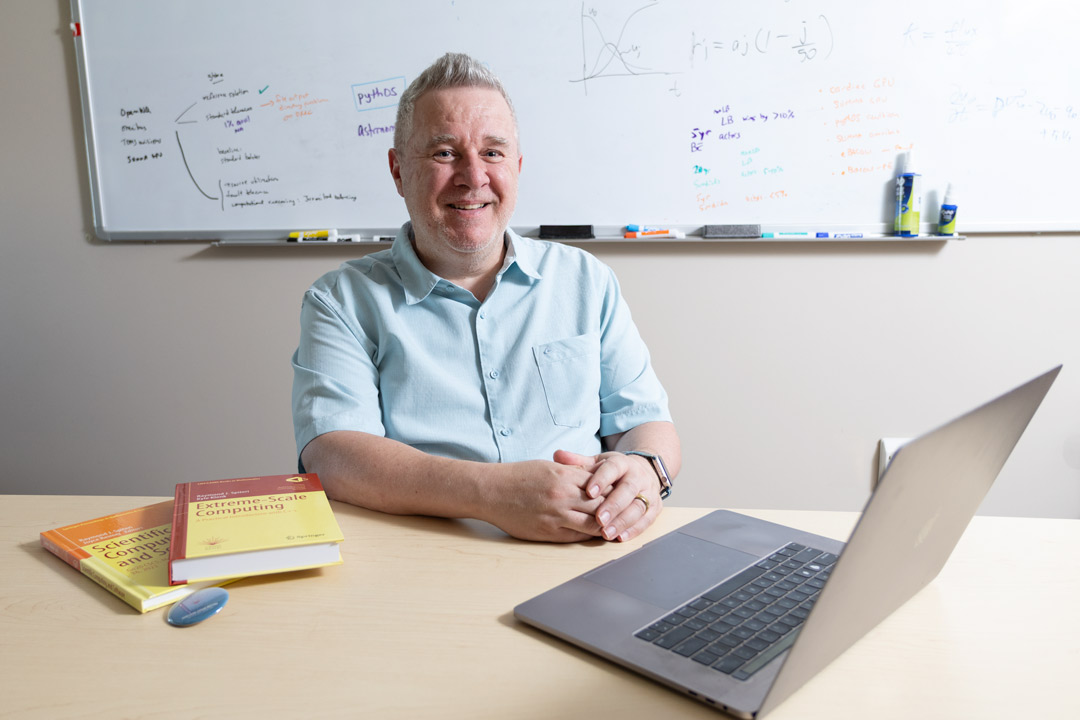
USask computer science professor wins national research prize
Dr. Raymond Spiteri (PhD) is recognized for contributions to applied and industrial mathematics
By Chris PutnamUniversity of Saskatchewan (USask) faculty member Dr. Raymond Spiteri (PhD) has received national recognition for his research that applies mathematics and computation to practical problems.
Spiteri is the winner of the 2026 CAIMS-SCMAI Research Prize from the Canadian Applied and Industrial Mathematics Society – Société Canadienne de Mathématiques Appliquées et Industrielles (CAIMS-SCMAI).
Spiteri said it is “a great honour” to receive the award from CAIMS-SCMAI, an organization that has been an important part of his professional life for many years.
“I also see the award as recognition of the people I have had the privilege to work with: undergraduate and graduate students, post-doctoral fellows, and collaborators from academia, industry, and the public sector. Much of my research is at the intersection of numerical analysis, scientific computing and applications, and progress in that space is rarely the work of one person alone.”
The CAIMS-SCMAI Research Prize recognizes innovative and exceptional research contributions in applied or industrial mathematics.
Spiteri—a professor in the College of Arts and Science’s Department of Computer Science and an associate member of both the Department of Mathematics and Statistics and the Department of Physics and Engineering Physics—was chosen for the award based on his ground-breaking contributions to the theory and practice of scientific computing.
Achievements cited by the prize committee included Spiteri’s development of new algorithms and software for solving complex physical models, and his influential methods for allowing differential equations to improve the efficiency and accuracy of predictions of real-world systems. Spiteri was also noted for his many scientific collaborations, especially in the areas of hydrology and plasma physics, and his exceptional contributions to educating computational scientists at the undergraduate, graduate and post-doctoral levels.
Spiteri—who has frequently collaborated with industry and was recently appointed co-director, careers for the Pacific Institute for the Mathematical Sciences (PIMS)—is drawn to problems where improvements in mathematical structure, algorithms and software design make a concrete difference in what scientists can compute.
“Most recently, I have been focused on problems where a standard process works, but only up to a point,” he said. “It may be too slow, too fragile, too difficult to scale, or too dependent on constant manual intervention. I find it invigorating to ask what drudgerous tasks the computer can take over so the human can be freed up to spend time on the activities that they do best: deciding what are the right questions to ask, how best to answer them, and how to interpret the results and their potential impact.”
The CAIMS-SCMAI Research Prize was presented to Spiteri at the society’s annual meeting in Regina, Sask., in June.